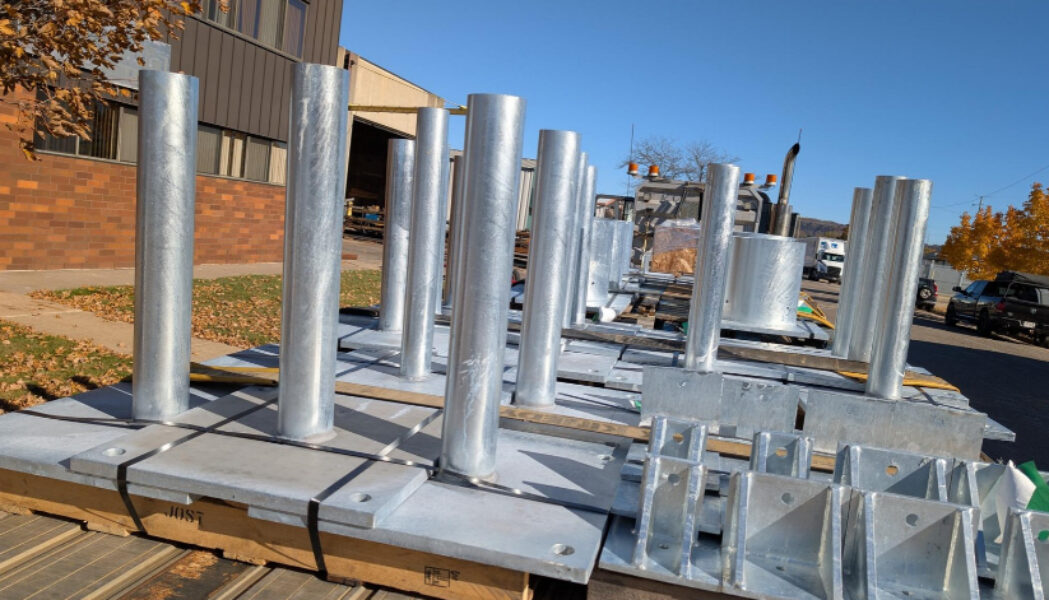
Fabricating a large steel component is only part of getting it successfully installed. After cutting, fitting, welding, inspection, surface preparation, and coating are complete, the finished steel still has to leave the fabrication facility, travel to the project, enter the jobsite, and arrive in a sequence that supports erection. Shipping large, fabricated steel components requires far more planning than placing finished pieces on a trailer. Weight, dimensions, trailer configuration, securement, permits, route restrictions, delivery timing, crane access, staging space, and erection sequence all influence how the steel moves from the shop to the field.
Those considerations become even more important for long girders, heavy welded assemblies, trusses, industrial support structures, bridge components, platforms, and other fabricated pieces that exceed normal transportation dimensions or require specialized handling.
A successful delivery starts long before the truck arrives at the loading area. Mid-City Steel considers shipping and logistics as part of the larger fabrication process, connecting production priorities with staging, load planning, transportation requirements, and the needs of the jobsite. The objective is to deliver the right steel, in the right condition, at the right time, and in an order that helps the field team keep moving.
Shipping Starts Before Fabrication Is Finished
Transportation planning should not wait until a large assembly reaches the end of fabrication. By then, many decisions affecting shipment have already been established. The size and geometry of a component influence trailer selection and route planning. Its weight influences loading position and legal axle limits. Connection details or shipping splits influence whether an assembly travels as one piece or several. Coating requirements influence blocking, securement, and handling. The erection sequence influences when the component needs to leave the shop.
These questions often begin during detailing and project planning. If a large assembly exceeds practical shipping dimensions, the project team might need to review a shipping split before fabrication proceeds too far. That split affects connections, drawings, fabrication labor, field assembly, inspection, and possibly coating. Addressing the transportation issue early gives the fabricator, engineer, contractor, and erector time to coordinate an appropriate solution.
Similar planning applies to heavy pieces. A member might fit within normal width and height limits while requiring a specialized trailer because of weight distribution. Another component might be relatively light but difficult to transport because of its length or irregular geometry.
Shipping therefore needs to remain connected to detailing, fabrication, project management, and erection planning rather than becoming a separate activity at the end of production.
Load Planning Balances Size, Weight, and Erection Needs
Building a steel load involves several competing requirements. The trailer needs to remain within applicable weight limits, the steel needs secure support, the load must travel safely, and the order of pieces should support efficient unloading and erection.
Weight distribution receives close attention because legal gross weight is only part of the transportation equation. Axle loading also matters, which means heavy members need deliberate positioning on the trailer. A load that falls within total weight limits might still create an axle issue if heavy components sit in the wrong location.
Geometry adds another layer. Long members require adequate support to limit movement during transportation. Curved, cambered, or irregular steel might require specialized blocking. Large assemblies need stable bearing points. Coated steel needs protection from contact areas that might damage the finished surface.
The order in which pieces are loaded matters too. A trailer packed efficiently from a transportation standpoint might create difficulties at the jobsite if the first piece needed for erection sits beneath several later pieces. When practical, load planning should account for the field sequence while still meeting transportation and securement requirements.
This coordination becomes especially valuable when the erector plans to pick steel directly from the trailer. The right member needs to be accessible when the crane is ready for the pick. Avoiding unnecessary unloading and restaging helps reduce jobsite congestion and material handling.
Piece Identification Keeps Every Component Connected to the Project
Large steel projects often involve hundreds or thousands of individual pieces. Each member needs a clear identity connecting it to drawings, fabrication records, shipping documents, and the erection plan.
Piece marks provide that connection. A piece mark allows the shop, shipping team, project manager, and erector to identify a specific fabricated component without relying on appearance alone. Two beams might look nearly identical while having different connection details, hole patterns, lengths, or installation locations. Clear marking reduces confusion as steel moves through fabrication, coatings, staging, loading, transportation, and erection.
Piece identification becomes especially important when assemblies include loose items. Bolts, plates, shims, clips, connection material, grating, rail components, and other smaller parts need organization so they arrive with the correct load and remain associated with the correct erection area.
Shipping documentation should support the same system. Load lists give the field team a record of what is scheduled to arrive, while piece marks help crews locate each component after unloading.
For complex projects, organized identification saves time at both ends of the shipment. The shop knows which pieces belong on each trailer, and the erector knows what has arrived and where each piece belongs.
Staging Connects Production With Shipping
Finished steel rarely moves directly from the final fabrication operation onto a waiting trailer. Most projects require a staging period between production and delivery. Staging creates a controlled area where completed pieces are organized according to project, load, delivery date, or erection sequence. Done well, staging supports efficient loading and helps confirm that a shipment is complete before the truck leaves.
Poor staging creates the opposite result. An early piece might sit beneath later material. A load might appear complete until someone finds one missing component still in welding or coatings. Finished steel might require repeated movement while the shipping team searches for the pieces needed for the next trailer.
Every extra move adds labor and creates another opportunity for coating damage, piece-mark confusion, or handling issues.
For that reason, staging should follow the same priorities driving the delivery schedule. Pieces intended for the same load or erection area should remain organized together when space and production flow allow. Production status also needs to remain visible so shipping teams know which pieces are complete, which still require inspection, and which are waiting on coating or another operation.
Large, fabricated components make staging even more important because moving them often requires cranes, forklifts, specialized rigging, or additional coordination. Good planning helps limit unnecessary handling.
Oversize and Overweight Loads Require Additional Planning
Many structural steel shipments travel within standard transportation dimensions. Large, fabricated components often fall outside those limits. A component extending beyond normal width, height, length, or weight requirements might need an oversize or overweight permit. Permit requirements vary by jurisdiction and by the dimensions of the load, so transportation planning needs to account for every state or local area along the route.
Permits might include restrictions on travel times, days of the week, routes, speeds, escorts, signage, lighting, or other conditions. Larger loads might require pilot vehicles or additional coordination with transportation authorities.
These requirements influence the delivery schedule. A load that cannot travel during certain hours might need to leave the fabrication facility at a specific time. Holiday restrictions might affect the shipping date. Construction zones might change the approved route. A permit delay might shift a planned delivery window.
The transportation provider and fabrication team therefore need enough lead time to secure required permits and understand the conditions attached to them. For project teams, this is another reason large-component logistics should enter the conversation early. A fabrication completion date does not automatically equal a departure date when permits and route restrictions still need resolution.
Route Planning Goes Beyond Finding the Shortest Drive
The shortest route between the fabrication facility and the jobsite is not always the route a large steel component is allowed or able to travel. Bridge clearances, overhead utilities, road widths, turning radiuses, weight-restricted bridges, construction zones, rail crossings, steep grades, and local traffic rules all influence route selection. Long trailers also need additional space at intersections and turns, while tall loads require careful clearance review.
Transportation providers often evaluate routes with the dimensions and weight of the specific load in mind. A route suitable for a standard flatbed might not work for a long girder or oversized assembly.
The final portion of the trip often deserves special attention. Interstate travel might present few challenges, while the last several miles introduce narrow roads, tight turns, temporary construction, residential streets, or restricted site entrances.
Those details need coordination before the truck reaches the area. For unusual shipments, route planning might also influence how the steel gets fabricated or divided for transportation. If no practical route exists for an assembly at its intended dimensions, the project team might need another shipping strategy.
Protecting Finished Steel During Transportation
Shipping does not end the quality-control process. Finished steel still needs protection as it moves from the fabrication facility to the project. Proper blocking and securement help prevent components from shifting during transit. Contact points need enough support to distribute weight and protect the member. Sensitive surfaces might require additional protection between steel and chains, straps, dunnage, or adjacent components.
Coated steel deserves particular attention. A high-performance coating system represents significant preparation, application, cure time, and inspection work. Poor handling during loading or transportation risks damaging a finish that has already passed through the entire coating process.
The geometry of the piece also influences protection. Curved steel, thin attachments, handrails, brackets, and projecting connection material might be more vulnerable to bending or impact than a standard beam. Loading crews need to understand where a component supports its own weight safely and which areas need clearance from adjacent pieces.
The goal is to preserve the condition achieved during fabrication so the steel arrives ready for installation rather than requiring avoidable repair.
Delivery Sequencing Should Support Erection
One of the most important shipping decisions is not how steel travels, but when each load arrives. Delivery sequencing should follow the field plan as closely as project conditions allow. If the erector plans to begin with a braced bay, the columns, beams, bracing, connection material, and related components needed for that area should arrive early enough to establish the structure. Steel for a later elevation or distant grid does little good if critical early pieces remain at the shop.
This becomes especially important on projects with limited laydown space. Urban sites, active industrial facilities, bridge projects, and constrained construction areas often have little room to store large quantities of steel.
In those situations, the trailer might function as temporary staging. The load arrives during a scheduled window, the crane picks the steel, and the truck leaves so the next delivery has room to enter. That approach places greater importance on fabrication and delivery sequencing. A missing piece interrupts erection, while an early load creates congestion. The shop, shipping team, project manager, contractor, and erector need current information about field priorities.
Schedule changes also need quick communication. Weather might delay erection. Concrete work might push a start date. Crane availability might change. Another trade might block access. When field conditions shift, shipping priorities sometimes need to move with them.
Jobsite Access Determines Whether the Load Reaches the Crane
A truck arriving at the project does not guarantee the steel has reached its destination. Jobsite access creates another group of practical questions. Is the entrance wide enough for the trailer? Does the driver have room to make the turn? Are temporary roads designed for the loaded vehicle? Is there enough room to back into the unloading area? Will parked equipment or stored material block the route?
Ground conditions also matter. A route that works during dry weather might become difficult after heavy rain. Temporary site roads need to support the vehicle weight. Winter conditions introduce snow, ice, and reduced maneuvering space. Large or long loads require even more room. The trailer might need to swing wide during turns or approach the crane from a specific direction. A delivery route through the jobsite should be reviewed with the actual trailer and load dimensions in mind.
Overhead conditions deserve attention too. Power lines, temporary utilities, scaffolding, cranes, building projections, and other obstacles might affect tall loads or unloading operations. Early communication between the contractor, erector, fabricator, and transportation provider helps resolve these issues before the delivery day.
Crane Access and Truck Positioning Need to Work Together
The relationship between the trailer and crane has a direct effect on unloading efficiency. When crews plan to erect directly from the truck, trailer position influences crane radius, pick weight, rigging, and the order of installation. The truck needs a clear path to the designated unloading point, and the crane needs access to the required pieces.
A load arriving in the correct sequence reduces unnecessary crane movement. The erector spends more time setting steel and less time searching through material or relocating components. Large assemblies require additional coordination because crane capacity changes with radius. A piece within the crane’s overall rated capacity might become too heavy at a longer working radius. Truck positioning therefore influences whether the planned pick works as expected.
The erector remains responsible for the erection plan and lifting operations, while the fabricator and transportation team support that plan by understanding delivery locations, load orientation, and sequence requirements. This coordination is particularly important when site conditions offer only one practical location for the trailer or crane.
Communication Keeps the Plan Current
Shipping plans are built around information available at a specific point in the project. Construction conditions rarely remain unchanged. Fabrication might progress faster or slower than expected. Coatings might affect a completion date. Weather might interrupt erection. A jobsite might temporarily lose access. A crane move might change where deliveries need to enter. Design revisions might shift which steel receives priority.
A strong logistics process needs communication between the shop and field. Project managers play an important role because they connect production status with contractor and erector needs. Shipping personnel need current delivery priorities, while field teams need accurate information about what is ready and what is scheduled to arrive.
Changes become harder to accommodate once a load is staged or placed on a trailer. A piece buried beneath several heavy members does not quickly move to the top because the field sequence changed. An oversize load with an approved permit also might have less flexibility than a standard shipment. Early notice gives the team more options.
Small Components Matter on Large Loads
Large, fabricated steel components attract most of the attention during transportation planning, but small items often determine whether installation proceeds. A heavy assembly arriving without the required connection plates, bolts, shims, clips, or other loose components might still be unusable. The crane and erection crew have the large piece, yet installation stops because a relatively small item is missing.
Shipping processes therefore need controls for loose material. Components should receive clear identification and packaging connected to the main assemblies or erection areas they support. Load documentation should tell the field team what arrived. Small items should also be packed in a way that protects them during transportation and makes them easy to locate after delivery.
The same principle applies to miscellaneous steel. Grating clips, rail components, stair hardware, ladder parts, and other small pieces need organization even when they share a trailer with much larger structural members. Successful logistics accounts for every component required to complete the work, not only the largest pieces on the load.
A Large Steel Shipment Is the Final Link Between the Shop and Field
Once it’s time for shipping fabricated steel components, significant work has already gone into it. Project teams have reviewed drawings, material has been purchased, detailers have developed fabrication information, operators have processed steel, fabricators have fit assemblies, welders have completed joints, inspectors have verified requirements, and coating personnel might have prepared and finished the surface.
Shipping protects the value of all that work. Load planning keeps steel supported and organized. Piece identification maintains traceability from the shop to the erection drawings. Staging supports efficient loading. Permits and route planning prepare oversized components for legal transportation. Delivery sequencing keeps the shipment aligned with erection priorities. Jobsite access planning helps make sure the truck reaches the place where the steel is needed.
When those pieces work together, the delivery becomes part of an efficient construction process rather than another problem for the field to solve.
Planning Shipping as Part of the Entire Steel Project The most effective transportation strategy starts before fabrication reaches its final stages. Large assemblies, unusual geometry, heavy pieces, demanding coating systems, restricted routes, and constrained jobsites all benefit from early logistics planning.
For contractors and project managers, several questions are worth discussing with the fabricator early in the project. Which components are likely to require specialized transportation? Are shipping splits needed? Does the erection sequence require specific load groupings? What restrictions exist at the jobsite? Are there designated delivery windows? How much laydown space is available? Will steel be picked directly from trailers? Are oversize permits likely? Answering those questions helps align detailing, production, staging, shipping, and erection around the same plan.
At Mid-City Steel, the work does not end when fabrication is complete. Moving large, fabricated steel components from the shop to the jobsite requires the same attention to planning, coordination, and detail used throughout production. When transportation is treated as part of the project rather than an afterthought, the steel reaches the field better prepared for the next step.
Planning a project involving large structural steel components, heavy assemblies, complex delivery sequencing, or restricted jobsite access? Talk with Mid-City Steel about fabrication and transportation requirements early so the shipping plan supports the project from the start.