When a steel project moves from drawings to fabrication, the finished product depends on much more than the equipment inside a shop. It depends on the systems behind the work: how requirements are reviewed, how materials are identified, how welding procedures are controlled, how inspections are documented, how coatings are applied, how nonconforming work is addressed, and how finished steel is prepared for delivery.
That is where structural steel fabricator certifications become important. Certifications do not replace an experienced team, capable equipment, or strong project management. They provide independent verification that a fabricator has established processes designed to produce consistent work and meet recognized industry requirements.
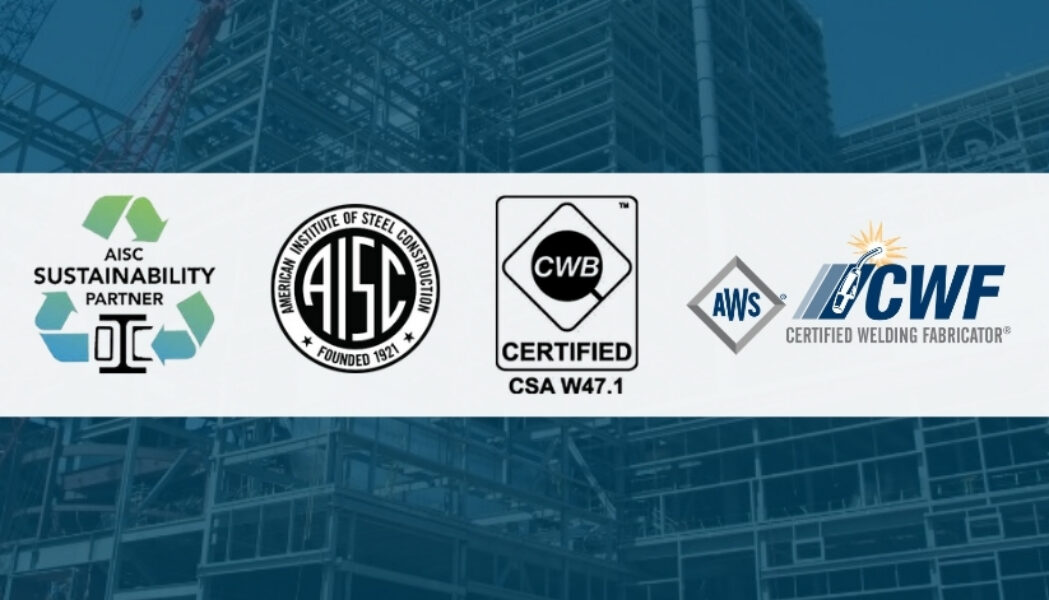
Mid-City Steel maintains AISC qualifications for building fabrication, intermediate bridge fabrication, hydraulic structures, fracture control, and complex coatings, along with AWS Certified Welding Fabricator (CWF) accreditation and CWB certification. Mid-City Steel also participates in AISC’s Sustainability Partner Program. Together, these qualifications reflect a quality-focused approach that supports projects ranging from commercial and industrial structures to bridges, hydraulic structures, and complex infrastructure.
For contractors, owners, engineers, and project managers, the value is practical. Certified processes create a stronger framework for controlling work before problems reach the field. They also provide greater visibility into inspection, documentation, welding, coatings, material control, corrective action, and delivery.
Structural Steel Fabricator Certifications Are About the Process Behind the Steel
A certification logo can be easy to overlook on a fabricator’s website or qualification package. The more important question is what had to happen behind the scenes for that certification to be earned and maintained.
AISC certification is built around a quality management system, or QMS. Rather than evaluating only a finished beam, column, plate assembly, or other component, the program evaluates the systems used throughout fabrication. Current AISC requirements address areas such as management responsibility, contract and specification review, document control, material identification, welding, bolting, inspection, equipment calibration, personnel qualifications, nonconformance, corrective action, recordkeeping, and delivery.
AISC’s certification process also involves independent review. Applicants and participating facilities are subject to documentation review and on-site audits, and deficiencies identified during the audit process must be addressed. That matters because a quality system is only useful when the procedures on paper are reflected in actual shop practices.
For a customer, this creates an important layer of confidence. The fabricator is not inventing a quality process from scratch for each new project. A documented framework is already in place for reviewing requirements, controlling fabrication, recording inspections, and responding when an issue is identified.
Mid-City Steel Qualifications at a Glance
| Qualification | What It Represents | Why It Matters to the Project |
| AISC Building Fabricator (BU) | Quality management for structural steel building fabrication from contract receipt through final delivery. | Consistent controls for documents, materials, fabrication, inspection, records, and delivery. |
| AISC Bridge Fabricator – Intermediate (IBR) | Bridge-specific quality requirements for intermediate bridge fabrication. | Established systems for bridge fabrication, welding, dimensional control, inspection, and documentation. |
| AISC Hydraulic Fabricator | Quality requirements for fabrication of hydraulic metal structures. | Process control for demanding geometry, welding, tolerances, handling, and project documentation. |
| AISC Fracture Control Endorsement (FCE) | Additional controls for designated bridge members subject to fracture control requirements. | Heightened discipline around critical welding, materials, inspection, testing, and traceability. |
| AISC Complex Coatings Certification | Qualification for shop application of complex protective coating systems. | Controlled surface preparation, coating application, environmental monitoring, inspection, and records. |
| CWB CSA W47.1 | Company certification for fusion welding of steel. | Qualified welding oversight, approved procedures, qualified welding personnel, and ongoing CWB review. |
| AISC Sustainability Partner Program | Sustainability program separate from AISC fabrication certification. | Additional evidence of sustainability education, environmental data tracking, policy, and goals. |
| AWS Certified Welding Fabricator (CWF) | Facility accreditation focused on the quality management system behind welding operations. | Established controls for welding personnel, procedures, material control, inspection, equipment, quality records, and shipment. |
AISC Certified Building Fabricator (BU)
The AISC Certified Building Fabricator program establishes quality management requirements for structural steel building fabrication. AISC describes the program as covering the fabrication process from receipt of the contract through final delivery.
That broad scope is important. Quality problems can begin long before a weld is made. A missed drawing revision, incorrect material identification, an uncontrolled procedure, or incomplete inspection record can create the same type of field disruption as a fabrication error. Building Fabricator certification requires the shop to manage the entire chain of activities that turns construction documents into fabricated steel.
For customers, the benefit is consistency. Project requirements are reviewed through an established system. Materials and documentation are controlled. Inspection responsibilities are defined. Equipment that affects quality is calibrated and maintained as required. Nonconforming work is identified and addressed through a documented process rather than handled informally.
On demanding building projects, those controls help support one of the outcomes every project team wants: steel that arrives ready for its intended sequence and fits the work in the field. Certification cannot guarantee that a project will never encounter a problem, but it provides a disciplined framework for reducing preventable errors and addressing issues when they occur.
AISC Certified Bridge Fabricator – Intermediate (IBR)
Bridge fabrication introduces additional demands that go beyond typical building work. Geometry, welding requirements, inspection, dimensional control, material traceability, documentation, and transportation agency specifications can all become more rigorous.
AISC separates bridge fabricators into Simple, Intermediate, and Advanced categories. The Intermediate Bridge Fabricator, or IBR, category covers typical bridge work that does not require the extraordinary measures associated with the Advanced category. AISC examples include certain rolled beam bridges, built-up plate girder bridges, and other intermediate configurations that require a fabricator to demonstrate bridge-specific capability.
For a contractor, transportation agency, engineer, or owner, IBR certification signals that bridge fabrication is supported by a quality system designed for that type of work. That matters because bridge projects often involve detailed specifications, hold points, nondestructive testing requirements, welding controls, dimensional tolerances, and documentation that must remain coordinated from material receipt through shipment.
A fabricator with an established bridge quality program can begin the project with those controls already integrated into its operation. Instead of building a bridge-specific quality structure for the first time after award, the organization has procedures, qualified personnel, records, and audit experience that support the work.
AISC Hydraulic Fabricator Qualification
Hydraulic steel structures present their own fabrication challenges. Depending on the project, these structures can involve large plate components, demanding fit-up, tight geometric tolerances, specialized welding, distortion control, machining, complex handling, or service conditions where reliability is critical.
AISC’s current hydraulic fabrication program includes Standard and Advanced categories. The Standard category covers hydraulic metal structures that do not require the sophisticated fabrication measures associated with the Advanced category, while the Advanced category addresses structures that demand more specialized controls related to factors such as size, curvature, plate thickness, distortion, machining, access, tolerances, and constraint conditions.
Mid-City Steel maintains an AISC qualification for hydraulic structures. For customers evaluating a hydraulic project, the important takeaway is the discipline behind that qualification: documented control of the fabrication processes that can directly affect fit, function, inspection, and long-term performance.
Hydraulic structures do not leave much room for improvised quality control. When large assemblies, critical welds, tight fits, or specialized components are involved, process control needs to be established early. A recognized certification framework helps demonstrate that those controls are part of the fabricator’s normal quality system.
AISC Fracture Control Endorsement (FCE)
Some bridge members require an even higher level of attention because the consequences of failure can be severe. AISC’s Fracture Control Endorsement focuses on the more stringent fabrication requirements associated with fracture control provisions for designated bridge members and components.
The endorsement evaluates whether a bridge fabricator has the capability to meet the additional demands associated with fracture control work. Those demands can involve material requirements, welding procedures, welder qualifications, inspection, nondestructive testing, repair controls, documentation, and traceability.
For project teams, the endorsement is meaningful because it shows that fracture control is not being treated as an ordinary extension of general fabrication. The fabricator has been evaluated against requirements intended for work where material condition, welding quality, procedural compliance, and inspection records receive heightened scrutiny.
That added discipline helps owners and contractors understand that critical members are being managed within a defined system. It also supports communication between fabrication, quality control, engineering, and project management when project-specific fracture control requirements need to be identified and documented.
AISC Complex Coatings Certification
Protective coatings are another area where the result depends heavily on process control. A high-performance coating system can fail prematurely if surface preparation, environmental conditions, mixing, application, cure, or film thickness are not properly controlled.
As of June 15, 2026, AISC uses the term Complex Coatings Certification for this program. It supersedes older Complex Coatings Endorsement terminology. The program is governed by AISC 420-25, the Certification Standard for Shop Application of Complex Protective Coating Systems, and evaluates fabricators and manufacturers that apply industrial coating systems such as zincs, epoxies, urethanes, and multi-coat systems in the shop after fabrication.
The practical value for a customer is that coating quality is treated as an engineered process, not simply as the final cosmetic step before shipping. Surface preparation must be controlled. Environmental conditions and application requirements must be monitored. Inspection and coating records need to support the specified system.
That process becomes especially important for bridges, industrial facilities, water and wastewater infrastructure, and other steel exposed to moisture, chemicals, weather, or aggressive service environments. A properly managed coating process can help protect the owner’s investment by supporting the intended performance of the specified corrosion-protection system.
AWS Certified Welding Fabricator (CWF)
Mid-City Steel also holds AWS Certified Welding Fabricator facility accreditation. The American Welding Society’s CWF program focuses specifically on the quality management system behind welding operations. The program is built around AWS B5.17, Specification for the Qualification of Welding Fabricators, and AWS QC17, Specification for AWS Accreditation of Certified Welding Fabricators.
For project teams, the value goes beyond confirming that individual welders can perform a specific process. AWS CWF accreditation addresses the fabricator’s overall welding program, including the personnel, procedures, knowledge, equipment, quality controls, and organizational capability needed to produce weldments in accordance with applicable requirements.
CWF facilities are responsible for areas such as contract documents and procedures, material control, welding, inspection, and shipment, and they must maintain an internal quality program aligned with AWS requirements. AWS also requires the accreditation to be maintained over time through internal audits and periodic recertification.
For customers evaluating welding quality and process discipline, the CWF credential provides another useful layer of qualification. It complements Mid-City Steel’s AISC and CWB credentials with an AWS framework focused specifically on how welding operations are managed and controlled.
CWB Certification to CSA W47.1
Mid-City Steel also maintains CWB certification. CSA W47.1 is the Canadian standard for certification of companies performing fusion welding of steel, and it places specific requirements around the people and procedures responsible for welding operations.
Under the CWB certification process, companies are required to qualify welding supervisors and, where applicable, welding engineers; submit welding procedures for review and acceptance; and qualify welders and welding operators for the processes and positions they use in production. CWB also conducts ongoing visits and audits as part of maintaining company certification.
For customers working on projects that reference Canadian welding requirements, this provides a clear advantage: the welding program has been independently reviewed against the applicable CSA framework. The company must have qualified oversight, approved procedures, and qualified welding personnel in place rather than relying only on internal practice.
Even on projects where the customer is simply evaluating overall welding discipline, CWB certification provides another useful indicator of process maturity. Welding quality depends on more than the skill of an individual welder. It depends on procedure control, consumables, supervision, qualification, inspection, equipment, records, and consistent execution across the shop.
AISC Sustainability Partner Program
Mid-City Steel also participates in AISC’s Sustainability Partner Program. It is important to describe this accurately: AISC identifies the Sustainability Partner Program as independent from its certification programs, so it is not an AISC fabrication certification in the same sense as Building Fabricator, Bridge Fabricator, or Complex Coatings.
The program is still relevant to customers evaluating a steel partner. Participating fabricators complete sustainability education, provide environmental data, and establish a sustainability policy and goal. AISC describes the program as a way to help fabricators reduce environmental impacts and contribute to sustainability-focused project outcomes.
For owners, architects, engineers, and contractors with sustainability objectives, that participation can provide additional context about how a fabricator is approaching resource use, waste, environmental performance, and continuous improvement. It complements Mid-City Steel’s quality qualifications without overstating sustainability participation as a fabrication certification.
What Certified Processes Mean During a Real Project
The individual structural steel fabricator certifications matter, but the greatest value becomes clearer when you look at how certified processes affect the day-to-day flow of a project.
Requirements are reviewed earlier. A quality management system creates defined responsibility for reviewing construction documents, specifications, revisions, and project-specific quality requirements. This helps the fabrication team identify special welding, inspection, coating, material, or documentation requirements before they become late-stage surprises.
Materials are controlled. Structural steel projects can involve multiple grades, heats, sizes, and components. Material identification and traceability procedures help keep the correct materials connected to the correct fabrication and documentation requirements.
Welding is procedural, not improvised. Certified welding programs depend on qualified personnel and documented welding procedures. This provides a controlled basis for how joints are prepared and welded and how welding-related requirements are verified.
Inspection is built into the process. At Mid-City Steel, quality is created throughout fabrication, not simply inspected at the end. Certified systems establish inspection responsibilities and records at appropriate stages so potential issues can be identified before they move farther downstream.
Measurement equipment is controlled. Inspection results only have value when the tools used to produce them are suitable and properly controlled. Quality systems include calibration and verification requirements for equipment that affects product quality.
Nonconforming work has a path forward. Certification does not mean mistakes can never happen. It means the company has a defined process for identifying nonconforming work, evaluating it, documenting the disposition, implementing corrective action when required, and learning from recurring issues.
Documentation supports accountability. When questions arise about inspection, material, welding, coatings, or delivery condition, organized records can help the project team understand what happened and when. AISC specifically emphasizes recordkeeping as part of an effective QMS.
Delivery is part of quality. Fabrication quality has little value if finished steel is damaged, poorly identified, or delivered without regard to the erection sequence. AISC’s Building Fabricator program extends through final delivery, reinforcing the idea that quality does not stop when fabrication is complete.
How Structural Steel Fabricator Certifications Help Reduce Project Risk
For many customers, the reason to care about certification is not the credential itself. It is risk management.
A structural steel project involves many handoffs. Engineers communicate design requirements. Detailers translate information into fabrication models and drawings. Purchasing brings in material. Fabricators cut, drill, fit, weld, finish, inspect, mark, stage, and ship components. Contractors then depend on those components arriving in the correct condition and sequence so erection can proceed.
Each handoff introduces the possibility of error. Certified systems create checkpoints, responsibilities, and records around those transitions. They help make quality repeatable instead of dependent on memory or individual habits.
That can support several project priorities at once: fewer preventable fabrication issues, clearer inspection documentation, stronger material and welding traceability, better control of special requirements, more disciplined corrective action, and greater confidence when fabricated steel reaches the jobsite.
Certification should not be interpreted as a guarantee of a perfect project. Steel fabrication is complex, and every project brings its own variables. The value is that the fabricator has a tested management framework for controlling that complexity and responding when conditions change or problems are identified.
What to Ask When Evaluating a Certified Steel Fabricator
Not all certifications apply to every project, and a long list of credentials only matters when the scope matches the work you need performed. During prequalification or procurement, project teams can use certification as the starting point for more useful questions.
Ask whether the fabricator’s certification category matches the project type. Confirm whether special requirements such as bridge work, fracture control, hydraulic structures, or complex coating systems fall within the facility’s current scope. Ask how project-specific quality requirements are identified during contract review. Understand what inspection records will be available. Discuss how material traceability, welding documentation, coating records, nonconformance, and delivery documentation will be handled.
Those conversations move certification from a checkbox into something more valuable: evidence of how the fabricator plans to control your specific project.
Quality Is Built Before Final Inspection
The most important lesson behind Mid-City Steel’s structural steel fabricator certifications is that quality cannot be added at the end of fabrication. Final inspection is necessary, but it cannot replace correct materials, controlled documents, qualified welding procedures, proper fit-up, accurate fabrication, compliant coatings, traceable records, and disciplined project coordination.
Mid-City Steel’s AISC qualifications, AWS Certified Welding Fabricator accreditation, and CWB certification represent systems, people, training, equipment, documentation, and accountability that are in place before a project begins. The company’s participation in AISC’s Sustainability Partner Program adds another layer of focus for customers with environmental and sustainability objectives.
For customers, those qualifications provide additional confidence that the steel is being fabricated within recognized quality frameworks designed to control work from project requirements through inspection and delivery. On a tough job, that kind of preparation matters.
Need a steel fabrication partner for a demanding project? Talk with Mid-City Steel about your project requirements, certification needs, fabrication scope, and delivery schedule.